

Today, we have Jackson Marsh on a visit, and he’s talking about his research behind The Clearwater Mysteries and The Larkspur Mysteries series which I found really interesting. Welcome, Jackson!
Hello everyone. I am Jackson Marsh, an author of MM romance, historical gay mystery, and the occasional ghost story. Today, I wanted to say a little about my research and my Victorian mystery series.
If I had to say what is my favourite thing about being an author, I would say research. If I was asked to give advice to an aspiring author of any genre, I would say, Learn to enjoy thorough research. Let me explain…
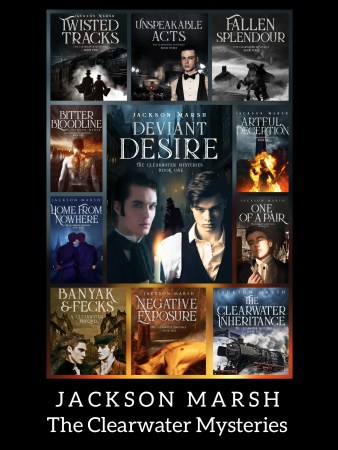 The Larkspur Mysteries carries on from the previous series, The Clearwater Mysteries, but you don’t have to read that collection of 11 novels in order to enjoy or understand the Larkspur stories. The Clearwater books start in 1888 at the time of Jack the Ripper, and are an ongoing set of adventures where the main characters are gay, living in a world where and when being gay was illegal. Within that outer casing of personal danger, we have the lives, loves and mysteries surrounding Lord Clearwater, his new-found love, Silas Hawkins, and his loyal friends and staff. The action mainly takes place in London, but sometimes moves to his country home in Cornwall, Larkspur Hall, and an academy he has established there for talented but disadvantaged young (gay) men.
In my books, I mix fact with fiction. Larkspur Hall doesn’t exist, though it is set on the edge of Bomdin Moor, a real place, and much of what you read in the stories actually exists, existed or happened. Sometimes, I involve people from the past, so in some of the Clearwater books, you find Bram Stoker, Henry Irving and others, and in the Larkspur series, we’ve already met Prince Albert Victor (Queen Victoria’s alleged gay grandson), we’ve also lived through the outbreak of Russian Flu in 1890, and we have delved into the mysteries of Cornish standing stones.
While all that is going on, we meet characters whose circumstances are based on real events. For example: Book one of the Larkspur Mysteries series, ‘Guardians of the Poor’, opens with Dalston Blaze, aged 18, in court on a charge of ‘intending to commit an unnatural act.’ Or, as we would say now, intending to sleep with his boyfriend. Intending to, note. Even intention of a homosexual act was grounds for up to two years in prison. Dalston’s court appearance is based on an article I found in the London newspapers of 1890 which involved a scandal at the Chelsea workhouse. I chose the Hackney workhouse for my setting because I’ve been there, and the story developed from there.
Without giving anything away, as the story unfolds, we meet Dalston’s love, a deaf pauper called Joseph Tanner, and we learn how the pair came to be in the workhouse, and how they came to fall in love. One of the challenges of writing Joe was his deafness. I am hearing, and I needed to find out how someone deaf from birth read, understood and ‘heard’ in their heads, as we do, and as we take for granted. So, I took a course in (modern) British Sign Language (BSL), talked to people and read articles, both academic and personal. I learnt, to my surprise, that although deaf schools and sign language had been in existence since the 1800s, sign language was outlawed in deaf schools at the time my Joe would have been brought up. I am now able to use basic BSL, and am thinking about taking another course in the language; or at least, refreshing my skills as there are no deaf, British people where I live.
Meanwhile…
‘Guardians of the Poor’ leads into the second book, ‘Keepers of the Past’ where Joe investigates the mysterious standing stones on Lord Clearwater’s estate. We also learn of a ten-year spree of unrelated murders, the magic and mystery surrounding the number 9, and see Joe and Dalston’s love tested as they adjust to life outside the workhouse.
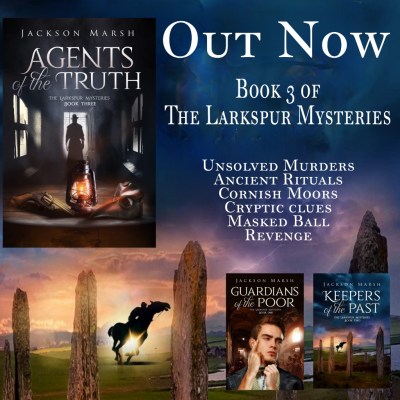 That story then leads nicely into number three, ‘Agents of the Truth’ which I released a couple of weeks ago.
‘Agents of the Truth’, like my other books, uses fact and fiction. I researched the fashion for masked balls, prisons in Victorian England, and archaeology. In this book, Joe meets famous (real) archaeologists such as Flinders Petrie, and the (then) young Howard Carter, as Dalston seeks to end the mystery that started in book one.
Now, I have started on book four of the Larkspur Mysteries, but it doesn’t yet have a title, other than the working title, ‘Chester Cadman’, the name of the new main character. Like the other Larkspur novels, this story is inspired by an article I found in a newspaper of the time, in this case, one about the Egyptian Hall in Piccadilly, and the Victorian obsession with mesmerism, spiritualism, and all things séance and other-worldly. I am delving into the realm of ghosts for this novel, and my research also includes monastic life in Medieval times, the landscaping of grand gardens and country homes, the winter wildlife of Cornwall, and a host of other fascinating things.
Now then, the thing is, there is no library near where I live, and although I am writing about London and Cornwall, I live in Greece. Mind you, I am not living in Victorian times either, so those things are hardly obstacles. It does help that I am British, have always loved history, been interested in crimes of the past, lived in Hackney, London for 12 years, and often visited Cornwall before I moved to Greece. Some of my research is based on my knowledge and experience, while the rest comes from reading, investigating and sideways thinking.
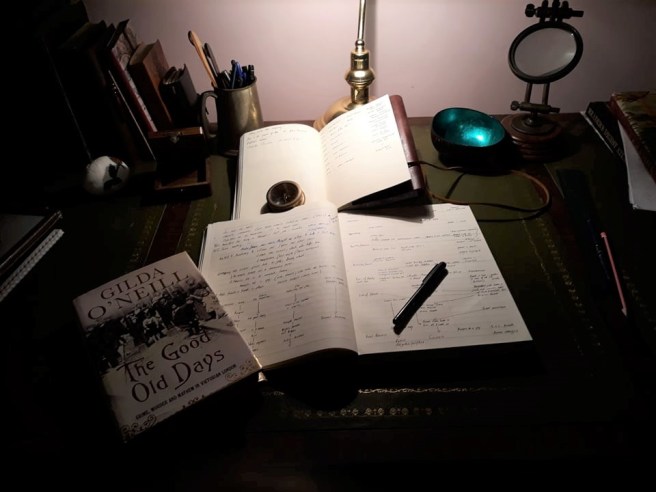
When I am not writing, I am reading history books, biographies and old newspapers. All are an invaluable source of inspiration and detail, and thanks to being online, the newspapers are only a click away. I use the National Newspaper Archive online to fix days of the week against dates, see what was going on in the world of my characters, find adverts to give authenticity, discover boat and train times, and I even look up the weather to help with authentic atmosphere.
And d’you know what? I love it. I enjoy my research as much as I enjoy inventing characters, but mostly, I enjoy mixing the two things and putting my created people into what was a living, breathing real world.
Jackson Marsh is the pen name of James Collins, and between my two selves, I have written over 35, full-length novels. Jackson’s MM Romance and gay historical mysteries can be found at my Amazon author page https://www.amazon.com/Jackson-Marsh/e/B077LDT5ZL/ and my backlist includes the Mentor series of age-gap romances, plus contemporary ghost and mystery novels.
Excerpt:
Excerpt from the first draft of The Larkspur Mysteries book three. As yet untitled, you are the first to read this!
Disturbed from its hunting in the copse, the owl landed atop the last remnants of the ancient church, and settled there, looking down to where monks had once processed to their altar. Its unmoving eyes focused on the place where worshipers had knelt, and its pupils shrank as a stray shaft of moonlight escaped its cloudy prison. The yellow irises glinted before it blinked, and its feathers gathered above its beak in concentration as its head turned.
Something in the night had changed. Not the scent of the kill, nor the desperate scurry of the fieldmouse; they were as always, and could wait. It was another hunt that made the owl drop from the wall, wings spread, eyes piercing, and swoop low over the lawns towards the moor.
A beat of silence, and it rose with the hill, turned, and looked back across the grounds, the ruined church, the massive Hall with its lights fading one by one, up to the tower, beyond and around. Hovering, wings shuddering, it cried a warning, and remained there, a sentinel of the night, watching and curious.
Below, from the deepest folds of the rising hill, a shape moved from dark to dimness. Made lustrous by fugitive moonbeams, the figure glided as soundlessly as a mist across the moor, and floated toward the ruins. Neither furtive nor afraid, fast nor faltering, it advanced with incandescent purpose as it had done hundreds of years before, until it reached the grey walls. There, it became one with rocks that absorbed its shape as they had once absorbed chants and prayers, and like the men who had offered them, it descended into the earth.
The night once again undisturbed, and the hunting ground her own, the owl twitched its head at the curiosity, and turned its hungry eyes to the affairs of the vulnerable fieldmouse.
Links:
Website: www.jacksonmarsh.com/
Facebook: https://www.facebook.com/jacksonmarshauthor
Amazon: https://www.amazon.com/Jackson-Marsh/e/B077LDT5ZL/
Queer Romance Ink: https://www.queeromanceink.com/mbm-book-author/jackson-marsh/


